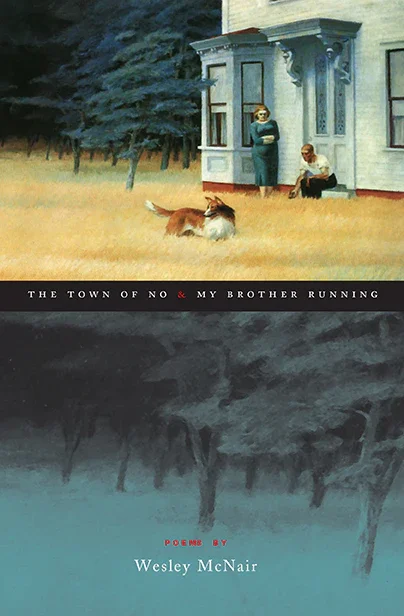
The Town of No & My Brother Running
David R. Godine, Publisher
Softcover
Pages: 176
Size: 5.5" x 8.25"
Published: March 1998
BUY NOW
This book gathers two of Wesley McNair's important early collections into one handsome volume.
In The Town of No, McNair blends sadness and comedy to remind us of Robert Frost's notion that poetry should make us "very sorry" or "very glad." In My Brother Running, fifteen short poems on rural life are counterbalanced by the long title poem, a memorial to a brother dead too soon and for reasons that can never be reconciled.
McNair's New England is not a nostalgic never-never land, but a place right on the ground, where signs advertise "Cosmetics and Landfill," poor people drive old Cadillacs, and farmers live on the edge. It includes children with intellectual disabilities playing baseball; old dancers gliding, eyes closed, on love-handles; and a desperate brother who runs until his heart explodes, on the very day NASA's Challenger rocket blows up.
Far broader than a regionalist poet, McNair seeks the universal meaning of his materials, linking his New England to American culture in general, and to the largest human concerns.
Critical Praise for The Town of No
"Profound and riveting . . . without a doubt, one of the year's best poetry collections. Full of poems that are simple and direct in technique, yet profound and riveting in impact. This is one of the year's best collections of poetry."
—Booklist (starred review)
“These are excellent poems, lucid poems, haunting poems.”
—Missouri Review
"Wesley McNair has created one of the most memorable mythical places of the decade."
—New Letters Review of Books
Critical Praise for My Brother Running
“McNair accomplishes the double miracle of being both entertaining and wise.”
—Down East Magazine
"The story of the speaker and his brother takes on a degree of obsessiveness that is more urgent than anything in McNair's snapshots from rural life, and the poem is without question his best."
—David Wojahn, Poetry
"Not a word out of place, and the lines move down the page with the stark clarity and the patient nearness of a winter landscape developing outside a window . . . whatever regional cast the poems have is much less noticeable than the powerful moments of realization and description that make these poems live."
—Henry Taylor, Washington Times
" . . . the book's title poem is a masterpiece of both pacing and intensity."
—Philip Booth, Maine Sunday Telegram
"McNair's most emotionally powerful poem, and a masterpiece of the long poem and the elegy."
—Thomas R. Smith, Minneapolis Star Tribune